
The following presentation by Fr. Gerald Murray was given at the 2018 Courage-EnCourage Conference which celebrated the centennial year of Father Harvey’s birth. Watch the video here.
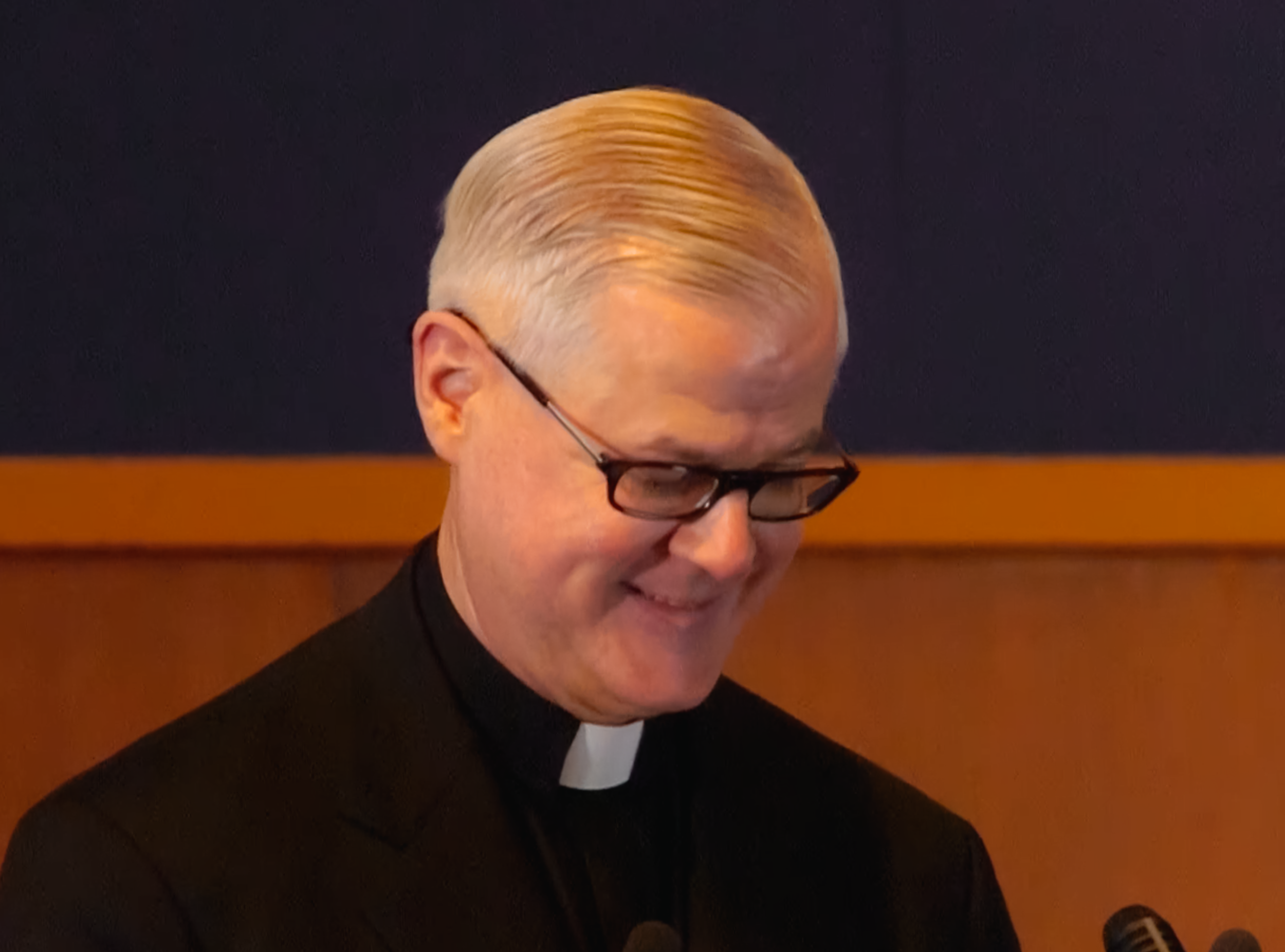
Fr. Murray giving this presentation in 2018
So we'll begin our talk this morning by praying an Our Father:
In the name of the Father and of the Son and of the Holy Spirit. Amen. Our Father, who art in heaven, hallowed be thy name. Thy kingdom come, thy will be done on earth as it is in heaven. Give us this day our daily bread, and forgive us our trespasses as we forgive those who trespass against us. And lead us not into temptation, but deliver us from evil. Amen. Our Lady of Lourdes- Pray for us ... pray for us. In the name of the Father and of the Son and of the Holy Spirit. Amen.
So it's a delight to be with you. I thank Father Bochanski for the invitation to speak at this Courage conference about the spiritual fatherhood of Father John Harvey. And as Father Phil mentioned, he was someone that lived at my rectory when I was at St. Vincent de Paul Church on West 23rd Street. He lived there for nine years, so I got to know Father Harvey very well from that. But I knew him before because, of course, New York is where Courage was founded.
Let me give a few details about Father Harvey's life:
He was born on April the 14th, 1918, so this is the 100th anniversary year. He was from Philadelphia, PA, and very proud Pennsylvanian his whole life. He attended the St. Columbus Parish School, and then he went to Northeast Catholic High School for boys. And he was attending... That's a big school. I was reading about it. At one point, it was the largest Catholic high school in the world. It had over 4,600 students, and believe it or not, there were 106 Oblates assigned to that high school, if you can believe that. So those Oblate fathers and brothers were the staff there. He decided to join them, and he went to their novitiate in 1936 in Childs, Maryland.
He made his first vows in 1937, and then perpetual vows in 1940. He was sent to Catholic University in Washington, DC, and he got a master's in psychology and in philosophy, and a license in theology. And then 10 years later, he completed a doctorate. So we all know he was a very well-educated man, and it's providential that he studied psychology, philosophy, because that contributed to his understanding of how to approach the Courage apostolate

Fr. Harvey teaches at Northeast Catholic High School from 1945 - 1947
Ordination to the priesthood during World War II, June 3rd, 1944, at the Cathedral of Saints Peter and Paul in Philadelphia. Now, Father Harvey was sent back to the high school he attended, Northeast Catholic High School, and he taught there from 1945 to 1947. Then he was sent back to the Catholic University in Washington from '47 to '51, and then that led to a career as a professor at the university level. So he taught at Dunbarton College of the Holy Cross from 1948 to 1973. Likewise, he was a professor at DeSales Hall School of Theology, which was the Oblate seminary residence there at Catholic University. Did that from 1949 to 1987, so just short of 40 years. And he was also the president from '65 to '77. He also taught at the Independent Theological Schools of Washington, DC from '80 to '83, and he taught at other institutions, including the Catholic Theological Union in Australia, and then St. Joseph's Seminary in Yonkers, New York, where I was a student and graduate.
Now, all of that teaching background of Father Harvey served him very well because he got to know young people, and he always had a youthful spirit about him, and he formed lifelong friendships with his students. One of his duties was also to teach summer school at Catholic U, and many religious sisters who were teachers in grammar schools and high schools, they would go there in the summers. So he got to know many religious women, and he was very much a person not detached from the life of the church as some professors might be if they were simply doing research. He was very much in touch. Now, from 1990 to 2010, he was a professor of medical and sexual ethics at Allentown College of Saint Francis DeSales, which changed its name to DeSales University, its current name, and that's where he lived at Wills Hall, a student residence. He additionally taught more at the Catholic University until 1997, but he is now best known for the work he did that is right here in front of us today, Courage, beautiful apostle of the Catholic Church, and that's how I came to know Father Harvey.
So let's review a little bit of that history. Cardinal Cooke was very concerned to help Catholics who have same-sex attraction to be able to live according to the Catholic faith, to live holiness, purity, and joy. And in the late '70s, in the archdiocese, there was a group called Dignity, which was not and is not a group recognized by the church and does not promote chastity or Catholic teaching. And Dignity was forbidden to use Catholic facilities, and Cardinal Cooke said we have to do something positive, offer an alternative he asked Father Benedict Groeschel to start a group. Father Benedict was one of my professors. I know he's well known to the people associated with Courage and he was a very busy man. Not that he didn't like that either. He would walk into our seminary, open the book, and say, "Okay, I'm teaching the same course at Maryknoll. Where am I here at Dunwoodie?" And depending on how well you were following the course, you might know the answer. In any event, Father Benedict was delightful, but he recommended to Cardinal Cooke that Father Harvey start the Courage Apostolate. So the two of them are considered the founders, but certainly Father Harvey is the main person getting this group going.
The initial membership, five people. First meeting, September 26, 1980, and meetings took place in the Shrine of Mother Seton, which is located at the South Ferry, which is right opposite the Staten Island Ferry, if you know that part of New York, and that's where Mother Seton had lived. So a very historic church, and I remember going down there a number of times for the Courage Apostolate. Now, Father Harvey continued at the head from 1980 all the way to 2008, so 28 years dedicated to the Courage Apostolate. He then retired in 2010, January, from living in New York and working at the Courage office, and he was at Annecy Hall in Childs, Maryland, and then he died on December the 27th, 2010, the Feast of St. John the Evangelist. The funeral was a few days later, December the 31st, in Elkton, Maryland, and then he's buried at the Oblates Cemetery in Childs, Maryland. So those are the bare facts, but they provide a reference to who Father Harvey was.
Now let me talk about my personal appreciation and love for Father Harvey. I was made pastor of St. Vincent de Paul, located on West 23rd Street in Manhattan, in 1998. It was the French national parish for the archdiocese, but also had masses in English for the people in the neighborhood. Father Harvey, at the time, was living at St. Michael's Church on West 34th Street, and the Courage office was there for a while. But that rectory is very big and has many flights, I think it's four stories high. No elevator. So Father Harvey knew that I had an elevator at my church. Providence works through circumstances such as who has an elevator. So Father Harvey asked if he could come to live in residence at my parish. So from 2001 to 2010, he lived at St. Vincent de Paul rectory, but it was not a full-time residence because he was still going to Allentown to do teaching duties, plus he did weekend assignments at parishes. So I typically had Father Harvey from Tuesday to Friday at the rectory. The Courage office was then located to St. John the Baptist Church, a Capuchin parish opposite Penn Station, where there was a large number of meeting rooms, and Courage was blessed to be invited to have their office there. So Father Harvey could walk from 24th Street, where the rectory was, back up to 34th Street, and he did that every day. But he was not simply doing that.
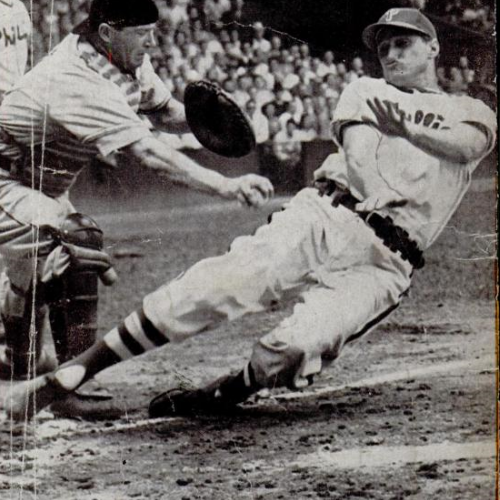
“He was a big Phillies fan.“
He would also weekly offer mass at Holy Innocents Church, which is on West 37th Street. He would offer two masses sometimes, 7:30, 8:00. One day a week, he would take a mass at my parish, a noonday mass, and then whenever he could, he came back for lunch. We do it Italian style, where lunch is the big meal. So 1:00, we'd have spaghetti, a main course, salad, fruit, cake, whatever you want. Our cook was very good. Father Harvey used to come back. So he'd take the 10-walk block rather than eat a sandwich at the office. He'd want to come down. Which means, of course, he was a very smart man because you don't turn up a good lunch. But he did it also for priestly fraternity, and we had great conversations at those meals. He loved so many different things. We didn't just talk religion. We talked baseball, and he was one of those people who could remember what inning the home run was hit, what year the batter had a 300 average. He was a big Phillies fan. He really loved baseball. And then we'd talk about other things in the life of the church. And naturally, given his long history, he knew everybody who was worth knowing when it comes to the Catholic Church in the East Coast of America. He had lots and lots of contacts that he made use of. So he would talk about different people that he had dealt with.
He was a hardworking man, and he would get up early. He would try to get a good night's sleep. But I remember one time-He overslept. The alarm didn't go off, so he got up at 8:00 rather than at 6:00, and he said to me, "I feel great." He got a great night's sleep. He also enjoyed a cocktail, which, of course, is not a sin in the catechism. Just excessive, but he was not that way at all. And he would love just to stop in my room and chat, bring up problems, difficulties. I have a friend who has season tickets to the Knicks, so we invited him to a game. I didn't know if he'd come. He said, "You bet I'll come." Went up to Madison Square Garden.
He liked to talk about his former students from those years teaching in Washington, DC. And he taught a lot of women, so of course, he was happy to talk about the young ladies who he had then known through their marriage, through having families. Some of them would invite him to come down to their house for vacations. He talked with great affection about them. He talked about the different people that he had dealt with, priests over the years. He was very much a priest's priest. He very much enjoyed the company of fellow priests.
Now, Courage as an apostolate from the early '80s, I certainly remember it. I remember Catholic New York, which is the archdiocesan newspaper, did a story when Courage was founded, and I was very encouraged by this apostolate. So after ordination, I was asked if I would be on a team of archdiocesan priests who would work with Courage. And I was only ordained maybe three years, so I said, "Let me go talk to Father Harvey, because you probably need a priest with more experience than a three-year-old, newly ordained priest." So I went down to see him, and as all of you who ever had a conversation with him know, he was a very good listener, very patient, sat me down, told me, "Don't worry. What counts is your enthusiasm and your interest, not your level of experience." So I went to Courage meetings at Our Lady of the Rosary. I went to hear a speech by Dr. Elizabeth Moberly, who spoke there, and Father Harvey thought a great deal of her and her writings.

Fr. Benedict Groeschel, CFR and Fr. John F. Harvey, OSFS
And then over the years, Father Harvey would talk to me about things involving Courage, involving the life of the church, the controversies that were arising. In the Archdiocese of New York, sad to say, there is unfortunate pressure from some quarters to have apostolates that do not reflect the Courage and Catholic philosophy regarding same-sex activity, and he was troubled by this and would share with me those problems. But he was also very encouraged by the support he was getting from other theologians and people such as Dr. William May, who would help him in analyzing documents coming from the Bishops' Conference and others. He really was a moral theologian at root when you get down to it, and moral theologians sometimes get a bad name because they say people interested in rules have hang-ups. And I wish Father Benedict was still around because he could explain that's not the case at all. People who are interested in rules are interested in freedom, and they're interested in respect of the rights of others. Because when you have a rule, then you know how your behavior can be directed in the right sense, and then you know when you're supposed to respect the rights of others and not interfere.
As a moral theologian, he was not quick to make a decision. I remember him asking me at times the questions, and I can't remember any specific examples, but questions in which the answer was not immediately obvious, so he would get my opinion. And then there's always the struggle in moral theology between rigorism and laxism, and then there's this idea of a golden mean. People say the middle between rigorism and laxism is going to be the truth, but that can be a deceptive analysis because sometimes the truth is shocking and therefore appears to be extreme, but in fact, really is the base position for happiness.
Now, Father Harvey was very much a pastor when it came to the mission of Courage. Courage was not primarily a self-help group designed to produce psychological peace and tranquility. Peace and tranquility are a fruit, rather, of closeness to God and of spiritual life, and Father Harvey knew that. He therefore, with the members of Courage when coming up with the five goals, completely put this under the aegis of a religious outlook. So I'll just read the five goals, brief comments:
To live chaste lives in accordance with the Roman Catholic Church's teaching on homosexuality. So this, of course, is a complete statement of what Courage is. It is an activity of the Catholic Church based on her teaching and appreciating, loving, and joyfully accepting that teaching. The teaching is not an undue burden or a restriction or in any way an imposition. Father Harvey believed that completely.He also believed that chastity is the key to happiness for everybody absolutely, but for people who have same-sex attraction, it's most important.
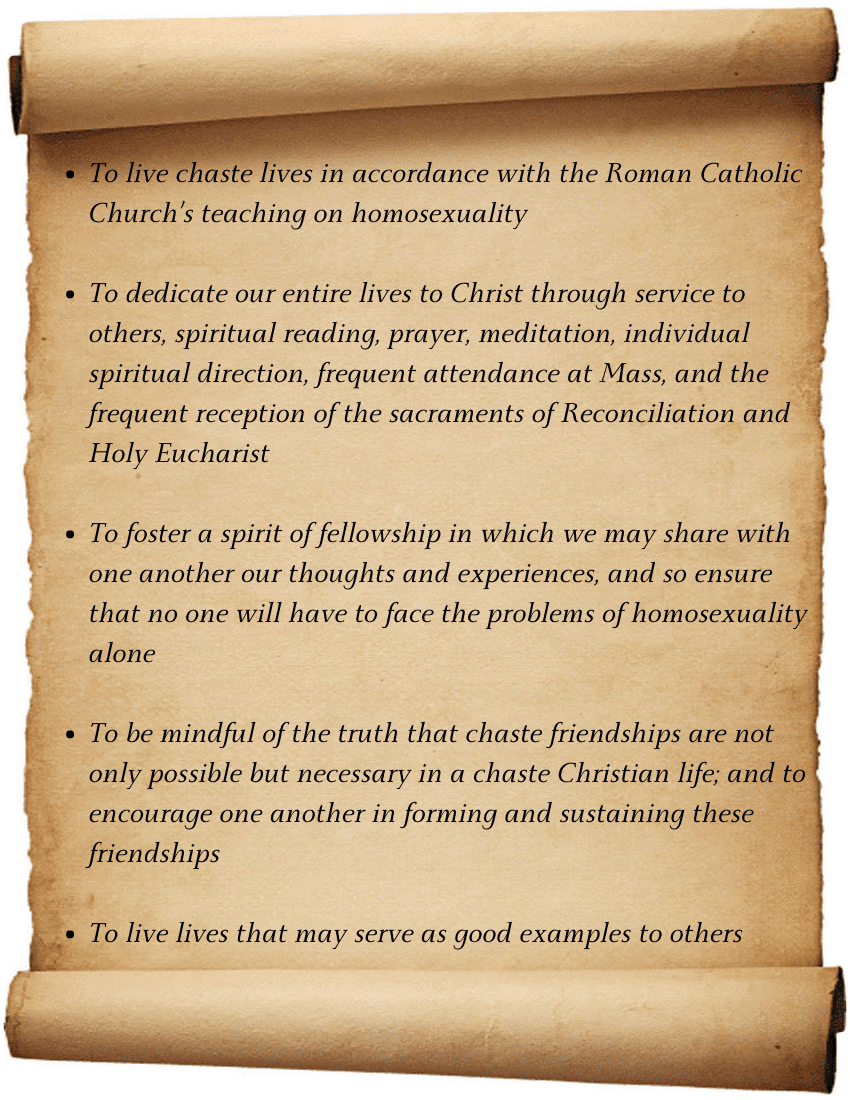
The Five Goals of Courage
Number two, to dedicate our lives to Christ through service to others, spiritual reading, prayer, meditation, individual spiritual direction, frequent attendance at mass, and the frequent reception of the sacraments of reconciliation and the Holy Eucharist, prayer, and dedication. So that goal should apply to every Catholic organization that exists because it is what the church is here to do. In order to love Christ, you must know Christ. In order to know Christ, you must use your heart and your head, and you must also use your hands because you know Christ through charity, through works of loving service. The sacraments are not add-ons. They are the essence of the Catholic life. When you ask a priest or seminarian, you ask him, "Why do you want to become a priest?" If the first answer is not because I want to celebrate mass, then you have to say, "We need some education here, son." Priests do a lot of stuff. Laypeople do a lot of stuff. The priest says mass. He offers the Holy Eucharist, and that's the source of the life of the church, Jesus. So Father Harvey knew that, and he encouraged spiritual life, which for some might appear to be too strict, but really wasn't. If you order your schedule, most people can do these different things. Now, maybe not every day, maybe not at different periods due to work, but mass and confession, spiritual reading, prayer, meditation. Now, individual spiritual direction, that was something he was good at because he was a good listener, and since he had so much experience in his life, he knew how to guide souls. Now, the psychological thing he also knew because he understood how sometimes people try to manipulate people through their presentation of difficulties, and he would sometimes get annoyed with people and say, "No, that's not the way to look at it." Now, I won't comment further because spiritual direction happens individually, but I do know that there were many people who had gotten guidance from him who were so grateful for that guidance.
The third goal, to foster a spirit of fellowship in which we may share with one another our thoughts and experiences and so ensure that no one will have to face the problems of homosexuality alone. Fellowship. And this, of course, is a very important aspect of the Courage Apostolate, fellowship. Fellowship means Christian friendship. It means loving one another in Christ and expressing that in a true way through helping the other soul to come closer to God, and then when facing a common problem, to do so with the support of others. Now, this spirit of fellowship, I knew Father Harvey was very-- We talked about this. Previous ways of dealing with people who had homosexual inclination or tendencies or activity was not to encourage friendships with people of the same sex because it was thought this would be a temptation, and this was a former way of looking at it. Father Harvey rejected that. Friendship is absolutely necessary to a healthy life for everyone except hermits. And then how many hermits are there? It's a very rare call. Not to criticize hermits, by the way. But for the most of us, man is a social creature. Go back to Aristotle. We know this. But in the Catholic Church, how do you do this for people who share a common problem? Well, that's what Courage is trying to do. And I've given a number of days of recollection for Courage over the years, and I appreciate that the talks are important and certainly the mass and confession, but also the fellowship of seeing people struggling with the same difficulty is a great support.
Number four, to be mindful of the truth that chaste friendships are not only possible but necessary in a chaste Christian life, and to encourage one another in forming and sustaining these friendships. So friendship in the individual sense now, not simply as a member of a group or coming together, but with individuals both sharing the same ideals, goals, and problems. This is absolutely important and in line with Father Harvey's understanding, which I think is very accurate, that at the origin of homosexuality often lies a misunderstanding of how to have healthy same-sex relationships. And friendship that is chaste and holy and blessed is necessary for everybody, but particularly for those who might be afraid of getting into good friendships. So he was big on that.
Lastly, to live lives that may serve as good examples to others. Good example, role model. And on this score, this is something that needs to be spoken about, I think, a little more. The existence of Courage is a light in the darkness for people who are going through same-sex problems in their lives. And to see happy, holy, well-adjusted members of Courage who do not flee from the church, but rather seek the church as her true mother and teacher, that's a good example for others. This is why when some people ignore Courage in their writings about homosexuality and say that the church has to change her teaching or practice, they've got that all wrong.That's a dead end. The example that Courage provides shows that the despair, and the sin, and the unhappiness that comes through immoral activity is not the only way of life for people who experience this condition. So, being a good example to others, very, very important. And in that regard, Father Harvey really was a good example.
And I'm inspired in part by what he did with EnCourage, forming a group for parents. And I remember he talked about that, how there was interest because he often became aware of people who could be potential Courage members through their parents contacting him. And he talked to me at different times about the anguish and the concern in people of that sort. I get that sometimes myself. Father Philip mentioned I go on TV sometimes, EWTN. Maybe you've seen "The Papal Posse." I hope you have. In any event, unfortunately with Father James Martin and others, there's a constant flow of information coming out that God made you this way, God wants you this way, and then he stops short of saying, "And God wants you to act this way." But then again, he never says, "God doesn't really want you to act this way," with any forcefulness. So I got a call the other day from a mother saying my son had read Father Martin's book. He thinks this is right. He also got some bad advice from a couple of priests. And she asked me if I'd be willing to meet with her son, and I said, "Sure. Why not? I'd be happy to help him." That is the kind of reason I think Father Harvey, in founding Courage, did want to make a counter-witness to the facile acceptance mode that so often is basically false charity, saying, "If somebody feels that they have to commit homosexual activity, well then who am I to judge and say that they can't do it? Who am I to say that this is immoral? God made..." Et cetera.
Now, I'll leave to other speakers more in-depth in that regard, because I do want to focus on Father Harvey's paternity or his spiritual fatherhood, and I thought I would refer to a couple of things he did and are printed in this book, "Same-Sex Attraction: A Parent's Guide," which is really an excellent book. And in it, I'll quote from two different parts.
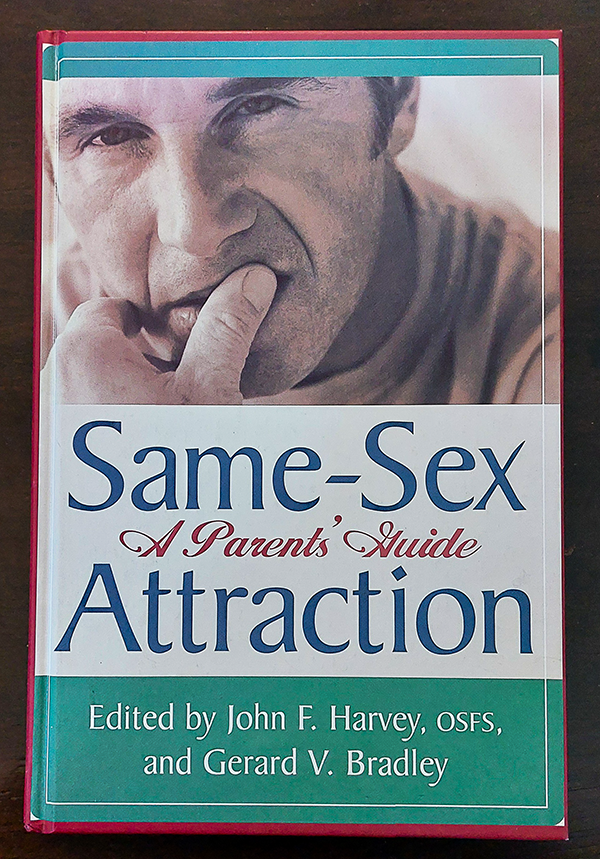
One is something many of you might be familiar with, questions and answers for parents of persons with same-sex attraction. And Father Harvey asks questions and gives answers, like a catechism. But I'll read some of the answers because they show his true paternal spirit as a Catholic priest. First question: What is homosexuality?
“There are many definitions of homosexuality. Traditionally, homosexuality has been described as a persistent and predominant attraction of a sexual, genital nature to persons of one's own sex. I use the term predominant to indicate that there may be a lesser degree of erotic interest in the other sex. I use the term persistent to indicate that these erotic feelings towards someone of the same sex have persisted beyond the adolescent phase.” So that answer's very good because it makes distinctions and tries to put things into a perspective. Now, in a philosophical nature, you can say friendship is a form of attraction, one to another, and that this is natural and good, and it is. In common parlance, when we have common interests with people or common activities, then we like spending time with those people. So that leads to relationships which are, in and of themselves, good. The problem becomes when the interest becomes eroticized and is a search for identity through sexual activity. And Father Harvey had different explanations that he proposed on how this happens. But he made distinctions and, of course, that's something that is priestly at heart. The general principle and the moral teaching of the church are not changeable. On the other hand, how you apply that to someone struggling with a difficulty in their life has to be based on what their actual condition is, and Father Harvey understood that.
Next, is homosexuality a sin? ”One must carefully distinguish between the condition of homosexuality and the homosexual acts. The condition of same-sex attraction is not a sin, but it is an objective disorder in the adolescent or adult person. If one gives in to the desire for same-sex acts, one always sins. Homogenital acts are evil by their very nature. This is why the inclination to such acts, though not sinful, is an objective disorder.” Now, Father Martin has written that we should no longer call it an objective disorder, that we should simply call it differently ordered rather than objectively disordered. Father Harvey and the church rejects that. The disorder is based on the understanding of the purpose that God made us in creation in the aspects of the human body and human soul, and the sexual faculty is meant for reproduction, and the sexual faculty is meant for complementary activity, male, female. Everything else is a diversion away from that, whether it be solitary sin or homosexual activity or other immoral acts. So we don't condemn people simply because they have a feeling or a desire, and that comes in this regard and in all others. On the other hand, we tell people the fact that one has feelings does not lead to the conclusion that those are good and therefore to be acted upon. Now, Father Harvey continues, "Some persons attempt to dilute the meaning of objective disorder by saying that any sin of lust is an objective disorder. Thus, if a man lusts for a woman or vice versa, this is an objective disorder. Yes, it is a serious sin, but is not a disorder, since the inclination of man for woman is good and natural when it is expressed in marriage. The reason why homosexual acts are evil by their very nature is that they do not fulfill the two basic purposes of human sexual genital acts, namely the union of man and wife in marriage and the hope of children. One may say, then, that homogenital acts are seriously sinful. If, however, the individual involved in such acts is not aware of their malice or has lost control of his will, he may not be guilty of mortal sin. Nevertheless, he has the obligation to seek moral truth and to use the means of overcoming his compulsive tendencies." So this is a beautiful and priestly way to deal with people, not simply in the confession box, but also in counseling and in just general conversation.
This is all being obscured by propaganda these days, and that is a serious problem. We had a bishop in Germany say a few months ago that the church should come up with a blessing ceremony for same-sex unions. What are we blessing there? Sodomy cannot be blessed. It is an immoral activity that's offensive to God, and it has no human purpose that is good. It has a disordered purpose, which is regarding lust and the illegitimate seeking of pleasure and other things, but it is not according to human nature. So the priestly soul of Father Harvey understood that people in their struggle with sin are often influenced such that they don't understand completely the evil of what they're doing, or that they are so habituated to sin that they're going to have to struggle over a long period to overcome it. And he didn't treat that as a reason to say, "I can't deal with you anymore." He was definitely a priest who was patient with people. I think I have till 10:30. Is that correct? Yes. Okay, good. So I got 10 more minutes. Maybe I'll leave a couple minutes for questions.
Now, Father Harvey answered this question: Does not the culture regard sexual abstinence by anyone, heterosexual or homosexual, as virtually impossible? “To be sure, the culture looks suspiciously at anyone who claims to live a chaste life. A television hostess challenged a priest who advocated a life of sexual abstinence. When he responded with the assertion that he was happy living a celibate life, the hostess said that the priest was either neurotic or had a low sex drive." "In short, the practice of sexual abstinence depends upon motivation." And this is really a problem in our culture today. We've gotten past the point of being shocked, but Hollywood stars that are the major money drawers are basically all involved in pornographic movies on a regular basis. Pornography used to be completely excluded. If you want to see the bifurcation of the liberal mind, The New York Times claims to be feminist, but they have a fascination with pornography. A porn star died about six months ago, and he was given a written obituary in The New York Times, not just a little box, but a story. And I said to myself, "What in the world did this man do to deserve this coverage in The New York Times?" He was attacking Christian morality by his way of life. That's the essential answer. So feminism doesn't count if the fight is to overthrow Christian morality. The same applies as regards homosexuality, and this is a big problem. To attack Catholic priests who are celibate or nuns as being neurotic or abnormal is just another diabolical technique to convince people that no one can live without sexual fulfillment or pleasure. Not the case. We know that, and that's one of the things Father Harvey communicated.
Let me just read another sentence. "Persons of homosexual inclination should practice sexual abstinence out of love for Christ. If one makes a vow or promise to abstain from sexual activity because of love for Christ, then this person may be regarded as living a life of consecrated chastity or celibacy. There are many men and women doing just that." And I think that's really very encouraging. There is no dead end as regards happiness and chastity. There are faults and there are failings, but God is good, and with the spiritual life, we are able to do much.
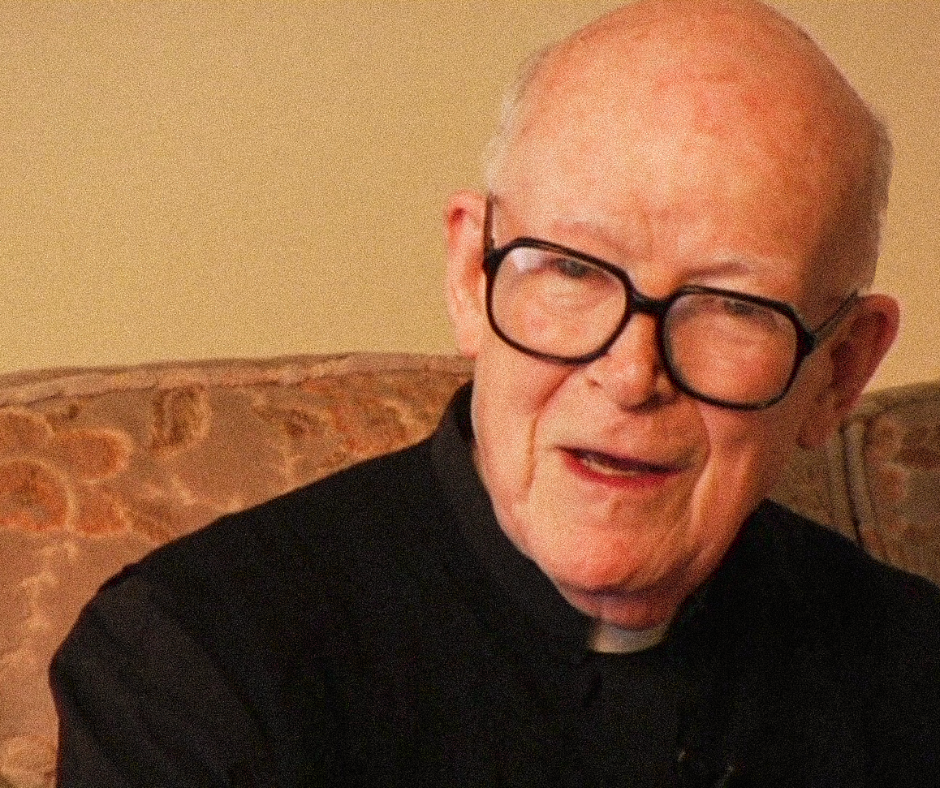
Fr. Harvey being interviewed for A Profile in Courage
Now, I'm going to read one last quote from Father Harvey, and this is concerning the use of the terms ‘gay’ and ‘lesbian’ in the document "Always Our Children," which was a document from the US Bishops Conference, which was subsequently revised after being criticized. And Father Harvey still found problems in the revised version. So this will be the final quote I read:
“I objected strongly to the use of the terms ‘gay’ and ‘lesbian’ in the original document, pointing out that the human person ‘can hardly be adequately described by a reductionist reference to his or her sexual orientation.’ “ And that comes from the "Doctrine of the Faith," 1986 letter. “The terms reappear in the revised document with a caution that they must be used ‘in honest and accurate ways.’ The common connotation of the terms ‘gay’ and ‘lesbian’ as understood in the secular media and as understood by those who label themselves such, is that the most important thing about them is their homosexual orientation. The individual will tell you, ‘This is who I am. I was born this way, and I will always be this way. I intend to live this way. I will find a lover of my own sex with whom I can express my natural sexual feelings.’
All right. He's setting up the problem. Here's the answer:
“As long as the individual thinks this way, he is prevented from seeing himself as he really is, a rational creature of God with free will, capable, by the grace of God, of controlling his sexual desires and, in some instances, as has been empirically established, of getting rid of the condition itself. Each of us is far more than a sexual orientation. Although the revised document acknowledges that our total personhood is more encompassing than sexual orientation, its acceptance of the terms ‘gay and ‘lesbian’ undercuts that very message. Instead of instructing parents to merely be sensitive to how your son and daughter is using those terms, it would be better to advise parents to discourage their son or daughter from labeling themselves as ‘gay’ or ‘lesbian’. “
So, there's a lot more we could say, and reading Father Harvey's writings is always refreshing. So I encourage you to get the books if you don't already have them, and look at them. But I'll leave a couple of minutes for questions and be happy to hear anything you have to say. Thank you.